Actual Rhythms Start practicing

Same rhythm, different notation

Michael Jackson plays a Chinese folk song.

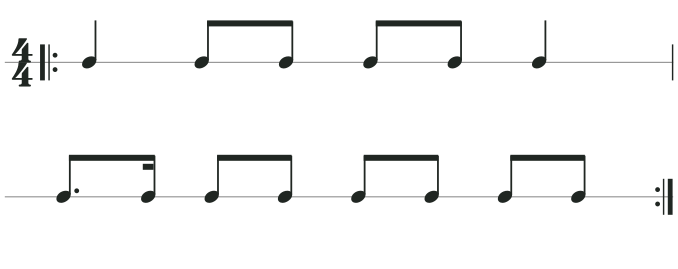
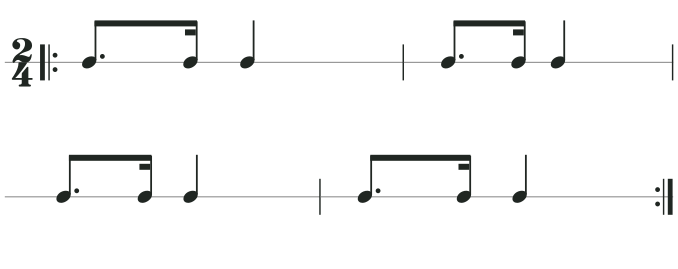
The bass line of Off the Wall has the rhythm of Mai wawa, a folk song from Shaanxi, note for note: the record bars it in 4/4, the song in 2/4. Only one other piece in the corpus has it, another Chinese folk song. Actual Rhythms finds matches like this across all 11,900 pieces, so every excerpt can show you its twins.

5,658 rhythms in the corpus are written more than one way; 4,984 of them in more than one time signature.


Two bars of 4/4: dotted eighth, sixteenth, two eighths, half; dotted quarter, eighth, two quarters.
Off the Wall Michael JacksonElectric bass, mm. 83–84 · recorded 1979
Four bars of 2/4: dotted eighth, sixteenth, two eighths; half; dotted quarter, eighth; two quarters.
Mai wawamm. 4–7 · China (Shaanxi, Jingbian), Essen folksong collection

Same notes, another meter

Identical on the page, a different time signature.

Nothing changes but the meter. In 2/2 the beat is the half note; in 4/4 it is the quarter. Read both and feel where the pulse moves.

Bach, Joplin and Gershwin

The bass of a Bach chorale is a line Gershwin wrote for They All Laughed. Joplin has it too, at half the values.


Two bars of 4/4: two quarters, half; eighth, quarter, eighth, two quarters.
Chorale BWV 408 J. S. BachBass, mm. 3–4 · Germany, harmonized c. 1714–1750
Two bars of 2/2: two quarters, half; eighth, quarter, eighth, two quarters.
They All Laughed George and Ira GershwinVoice, mm. 29–30 · USA, first performed 1937
Two bars of 2/4: two eighths, quarter; sixteenth, eighth, sixteenth, two eighths.
Original Rags Scott JoplinPiano, mm. 57–58 · published 1899

Dizzy Gillespie, a Welsh tune and a folk song from Shanxi

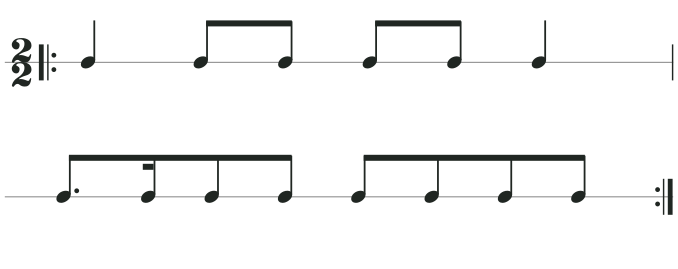
Bebop, Wales and China, note for note: the Welsh tune in 2/2, the trumpet solo and the Chinese song in 4/4.
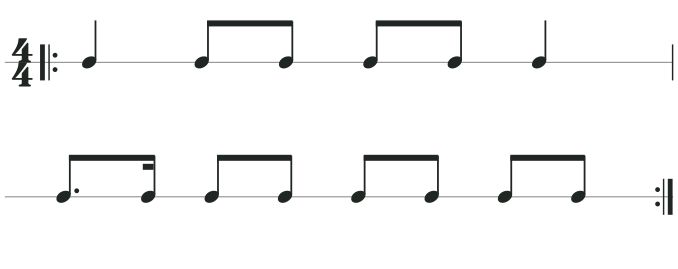
Two bars of 4/4: quarter, four eighths, quarter; dotted eighth, sixteenth, six eighths.
Be-Bop Dizzy GillespieTrumpet solo, mm. 34–35 · recorded 1945
Two bars of 2/2: quarter, four eighths, quarter; dotted eighth, sixteenth, six eighths.
Sweet RichardA Welsh tune, mm. 2–3 · Aird's Airs, Glasgow, 1782–1803
Two bars of 4/4: quarter, four eighths, quarter; dotted eighth, sixteenth, six eighths.
Zuoquan jiangjunmm. 4–5 · China (Shanxi, Zuoquan), Essen folksong collection

Toto, an Irish tune and a Tyrolean song

The dotted figure under Africa is an Irish tune from O'Neill's collection, note for note, and a Tyrolean song that writes it as four bars of 2/4.


Two bars of 4/4, each: dotted eighth, sixteenth, quarter, twice.
Africa TotoSynthesizer (left hand), mm. 3–4 · recorded 1982
Two bars of 4/4, each: dotted eighth, sixteenth, quarter, twice.
By the Brooksidemm. 18–19 · Ireland, O'Neill's Music of Ireland, 1903
Four bars of 2/4, each: dotted eighth, sixteenth, quarter.
Z'Lauterbach hab i mei Strumpf verlorenPickup and mm. 1–3 · Tyrol, published 1838–1840

Charlie Parker and an Irish reel

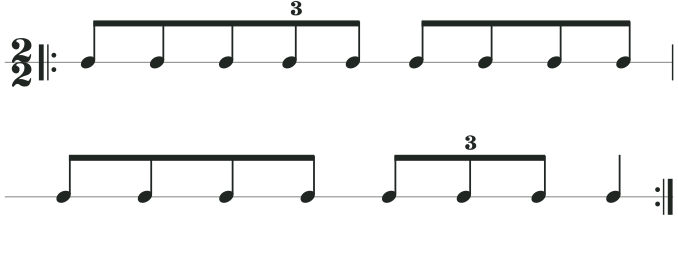
Bebop triplets and a fiddler's ornament triplets land in the same places. Only the meter differs.
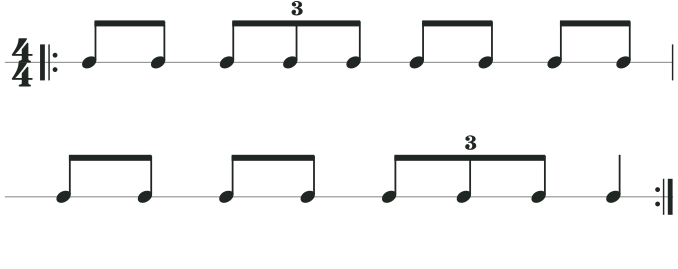
Two bars of 4/4: two eighths, an eighth-note triplet, four eighths; four eighths, an eighth-note triplet, quarter.
Marmaduke Charlie ParkerAlto sax solo, mm. 57–58 · Harry Smith Studios, NYC, 1948 · from Charlie Parker 60 Melodies and Solos
Two bars of 2/2: two eighths, an eighth-note triplet, four eighths; four eighths, an eighth-note triplet, quarter.
Repeal of the Unionmm. 2–3 · Ireland, O'Neill's Music of Ireland, 1903

Gerry Rafferty, Clifford Brown and Haydn

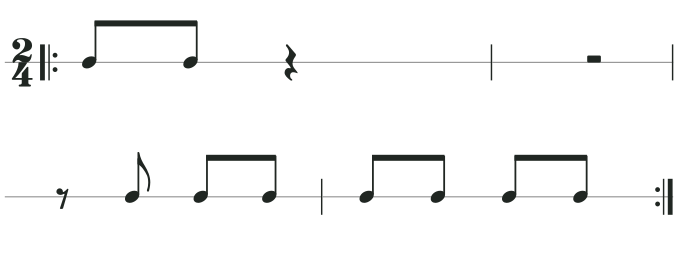
A 1978 hit, a bebop solo and an early Haydn quartet, which writes it as four bars of 2/4. Parker's Leap Frog has it too.


Two bars of 4/4: two eighths, quarter rest, half rest; eighth rest, seven eighths.
Right Down the Line Gerry RaffertyVocal, mm. 69–70 · from City to City, 1978
Two bars of 4/4: two eighths, quarter rest, half rest; eighth rest, seven eighths.
A Night in Tunisia Clifford BrownTrumpet solo, mm. 9–10 · recorded 1954
Four bars of 2/4: two eighths, quarter rest; half rest; eighth rest, three eighths; four eighths.
String Quartet Op. 1 No. 1, mvt. 5 Joseph HaydnCello, mm. 21–24 · Austria, composed c. 1757–1762

Cannonball Adderley, Beethoven and a folk song from Shanxi

Three continents and three meters: Zawinul's tune in 4/4, Beethoven's viola in 2/2, and the folk song in 2/4 at half the values.


Two bars of 4/4: quarter, eighth rest, eighth, quarter, eighth rest, eighth; whole note.
Mercy, Mercy, Mercy Cannonball AdderleyAlto saxophone, mm. 41–42 · tune by Joe Zawinul
Two bars of 2/2: quarter, eighth rest, eighth, quarter, eighth rest, eighth; whole note.
String Quartet Op. 59 No. 2, mvt. 4 Ludwig van BeethovenViola, mm. 145–146 · Vienna, composed 1806
Two bars of 2/4: eighth, sixteenth rest, sixteenth, eighth, sixteenth rest, sixteenth; half note.
Nao yuanxiaomm. 22–23 · China (Shanxi, Qitai), Essen folksong collection

Half or double the note values

Same rhythm, different note values.

Halve every note and a bar of 4/4 becomes a bar of 2/4. Double them and two bars become four. The rhythm doesn't change; only how busy it looks.

Charlie Parker and Jingle Bells

The riff of Now's the Time is Jingle Bells at half the note values. Mozart's "Hunt" Quartet, Beethoven and three folk songs from Germany, Austria and the Baltic have it too: seven pieces in four spellings.

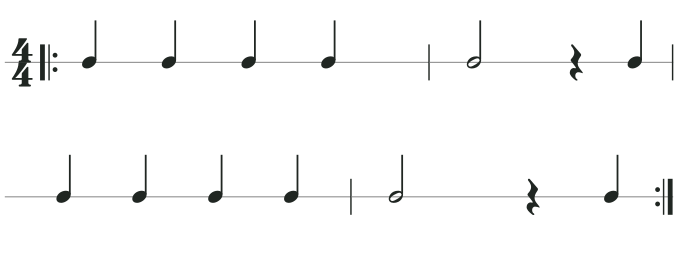
Two bars of 4/4, each: four eighths, quarter, eighth rest, eighth.
Now's the Time Charlie ParkerAlto sax, head, mm. 9–10 · WOR Studios, NYC, 1945 · from Charlie Parker 60 Melodies and Solos
Four bars of 4/4: four quarters; half, quarter rest, quarter; four quarters; half, quarter rest, quarter.
Jingle Bells James PierpontVoice, mm. 5–8 · USA

Scott Joplin, a South Indian krti and Walter Donaldson

A Carnatic composition in 4/4, a rag that writes it in sixteenths, and a 1930 song that writes it at twice the values over four bars of 2/2.


Two bars of 4/4: whole note; three eighths, quarter, eighth, quarter.
Krtimm. 8–9 · South India, Essen folksong collection
Two bars of 2/4: half note; four sixteenths, the last tied, two sixteenths, eighth.
Rose Leaf Rag Scott JoplinPiano, mm. 33–34 · published 1907
Four bars of 2/2: whole note tied to a whole note; four quarters, the last tied; two quarters, half.
You're Driving Me Crazy Walter Donaldsonmm. 1–4 · USA, first performed 1930

Miles Davis and Beethoven's Grosse Fuge

A trumpet line from Bitches Brew is a viola line from Beethoven's Grosse Fuge, written in sixteenths. His Op. 59 No. 1 has it too.


Two bars of 4/4: whole rest; eighth rest, three eighths, quarter, quarter rest.
Miles Runs the Voodoo Down Miles DavisTrumpet, second solo, mm. 86–87 · recorded 1969
Two bars of 2/4: half rest; sixteenth rest, three sixteenths, eighth, eighth rest.
Grosse Fuge, Op. 133 Ludwig van BeethovenViola, mm. 161–162 · Vienna, composed 1825

Scott Joplin and a folk song from Liaoning

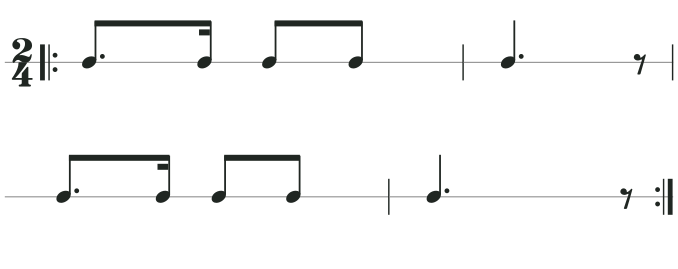
A march from 1896 and a Chinese folk song, the march in 4/4 and the song in 2/4 at half the values.
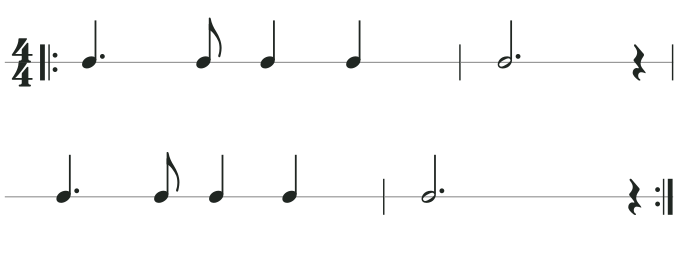
Four bars of 4/4: dotted quarter, eighth, two quarters; dotted half, quarter rest; repeated.
Combination March Scott JoplinPiano, mm. 68–71 · published 1896
Four bars of 2/4: dotted eighth, sixteenth, two eighths; dotted quarter, eighth rest; repeated.
Qiao qing langPickup and mm. 1–3 · China (Liaoning), Essen folksong collection

Coltrane and Beethoven

Coltrane's 3/4 on My Favorite Things is Beethoven's 3/8, note for note at half the values.

Two bars of 3/4: quarter rest, eighth rest, three eighths; dotted half rest.
My Favorite Things John ColtraneSoprano sax solo, mm. 32–33 · recorded 1960
Two bars of 3/8: eighth rest, sixteenth rest, three sixteenths; dotted quarter rest.
String Quartet Op. 59 No. 1, mvt. 2 Ludwig van BeethovenViola, mm. 161–162 · Vienna, composed 1806

Coltrane and Monteverdi

A phrase from Impressions is a line from a Venetian madrigal at twice the note values.

Two bars of 4/4: quarter, two eighths, quarter, dotted eighth, sixteenth; quarter, two quarter rests, two eighths.
Impressions John ColtraneTenor sax solo, mm. 333–334 · recorded 1963
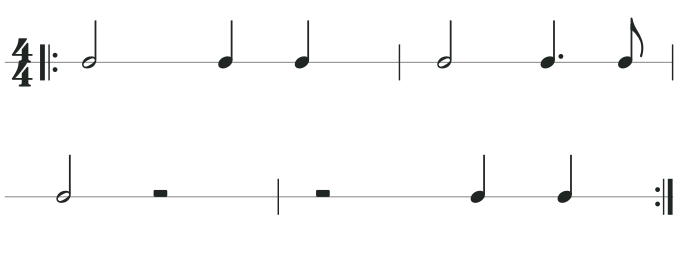
Four bars of 4/4: half, two quarters; half, dotted quarter, eighth; half, half rest; half rest, two quarters.
Stracciami pur il core Claudio MonteverdiQuinto, mm. 33–36 · Venice, published 1592

Charlie Parker and Monteverdi

A syncopated bebop phrase and a tenor line from a Venetian madrigal. Monteverdi writes it at twice the note values, over four bars, more than 350 years earlier.

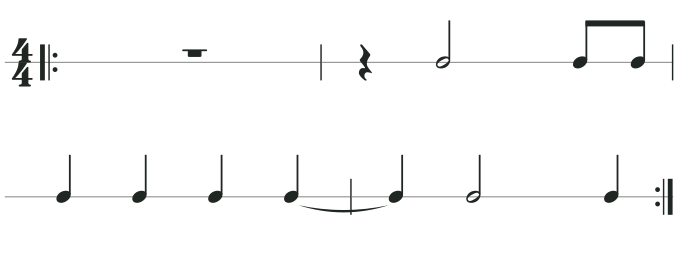
Two bars of 4/4: half rest, eighth rest, eighth tied to eighth, two sixteenths; three eighths, eighth tied to eighth, quarter, eighth.
My Little Suede Shoes Charlie ParkerAlto sax solo, mm. 33–34 · Verve MGV 8008 · from Charlie Parker 60 Melodies and Solos
Four bars of 4/4: whole rest; quarter rest, half, two eighths; three quarters and a quarter tied over; quarter, half, quarter.
Vattene pur, crudel, con quella pace Claudio MonteverdiTenor, mm. 29–32 · Venice, published 1592

Earth, Wind & Fire, Beethoven and Monteverdi

A piano part from After the Love Has Gone, Beethoven in four bars of 2/4, and Monteverdi at twice the values.


Two bars of 4/4: half rest, dotted quarter rest, eighth; four eighths, quarter, two eighths.
After the Love Has Gone Earth, Wind & FirePiano, mm. 43–44 · tune by David Foster, Jay Graydon and Bill Champlin
Four bars of 2/4: half rest; quarter rest, eighth rest, eighth; four eighths; quarter, two eighths.
String Quartet Op. 18 No. 1, mvt. 4 Ludwig van BeethovenViolin II, mm. 257–260 · Vienna, composed 1798–1800
Four bars of 4/4: whole rest; half rest, quarter rest, quarter; four quarters; half, two quarters.
Voi pur da me partite, anima dura Claudio MonteverdiAlto, mm. 77–80 · Venice, published 1603

Empire of the Sun and Beethoven

The bass line of Walking on a Dream is a Beethoven viola part at half the values, two centuries earlier.


Two bars of 4/4: whole rest; eighth, eighth, eighth rest, eighth, twice.
Walking on a Dream Empire of the SunElectric bass, mm. 56–57 · tune by Luke Steele and Nick Littlemore
Two bars of 2/4: half rest; sixteenth, sixteenth, sixteenth rest, sixteenth, twice.
String Quartet Op. 59 No. 1, mvt. 4 Ludwig van BeethovenViola, mm. 199–200 · Vienna, composed 1806

Ties and beats

The same durations, grouped another way.

A tie or a single note, three beats or two: writers split the same durations differently, often to show where the beat falls. The sound doesn't change.

Wayne Shorter and Beethoven

Shorter's chain of tied eighths in 3/4 is Beethoven's quarters across the beat in 6/8. A good pair for teaching three against two.


Two bars of 3/4: eighth rest, then eighths tied across each beat; the same, ending on an eighth.
Juju Wayne ShorterTenor sax solo, mm. 112–113 · recorded 1964
Two bars of 6/8: eighth rest, two quarters, eighth tied over; eighth, two quarters, eighth.
String Quartet Op. 59 No. 2, mvt. 1 Ludwig van BeethovenViolin II, mm. 93–94 · Vienna, composed 1806

The Carpenters and an Irish tune

One tie apart: where the bass plays a quarter, the tune writes two eighths tied together.

Two bars of 4/4: four eighths, two quarters; quarter, dotted eighth, sixteenth, quarter, two eighths.
We've Only Just Begun The CarpentersElectric bass, mm. 41–42 · recorded 1970
Two bars of 4/4: four eighths, quarter, eighth tied to eighth; quarter, dotted eighth, sixteenth, quarter, two eighths.
Rodney's Glorymm. 4–5 · Ireland, O'Neill's Music of Ireland, 1903

Scott Joplin and a folk song from Taiwan

Joplin's Heliotrope Bouquet ties into the last eighth where the song holds a dotted quarter. His Reflection Rag has the song's rhythm exactly.


Two bars of 2/4: eighth, six sixteenths; quarter tied to eighth, eighth rest.
Heliotrope Bouquet Scott JoplinPiano, mm. 69–70 · published 1907
Two bars of 2/4: eighth, six sixteenths; dotted quarter, eighth rest.
Yuanyuan kan mei mei fei laimm. 4–5 · Taiwan (Hsinchu, Miaoli, Taoyuan), Essen folksong collection

Beethoven and a song from Hawaii

A late Beethoven quartet and a 1933 hapa haole song, one tie apart: a dotted half against a half tied to a quarter.


Two bars of 4/4: dotted half, dotted eighth, sixteenth; quarter, dotted eighth, sixteenth, two quarters.
String Quartet Op. 132 Ludwig van BeethovenViola, mm. 137–138 · Vienna, composed 1825
Two bars of 4/4: half tied to quarter, dotted eighth, sixteenth; quarter, dotted eighth, sixteenth, two quarters.
My Little Grass Shack in Kealakekua, Hawaii Cogswell, Noble and Harrisonmm. 13–14 · USA, first performed 1933

How matches are found

Proportions, not symbols.

For every excerpt, the app notes where each attack and each rest begins, as a fraction of the whole excerpt, with tied notes merged into one. Two excerpts with the same fractions are the same rhythm, whatever the time signature, the note values or the number of bars.

In the app, the source card under each excerpt counts the other pieces that write its rhythm another way, and names their time signatures. One tap shows every one of them side by side.

  • 5,658 rhythms are written more than one way in the corpus.
  • 4,984 of them appear in more than one time signature.
  • 7 pieces share the Now's the Time rhythm, in four spellings: Parker, Jingle Bells, Mozart, Beethoven and three folk songs.
  • 3 pieces have the Off the Wall bass rhythm: Michael Jackson's record and two Chinese folk songs.

Learn the rhythm, not just the spelling.

Read it in 2/4, then in 4/4, then in 6/8. Every excerpt is real music.

Start practicing